

Why YESTERYEAR Works
My personal take on why this book has become a phenomenon.

I felt my heart swell throughout the final chapter, and then it exploded - shattered into a million pieces.
This was my response to the ending of this book.
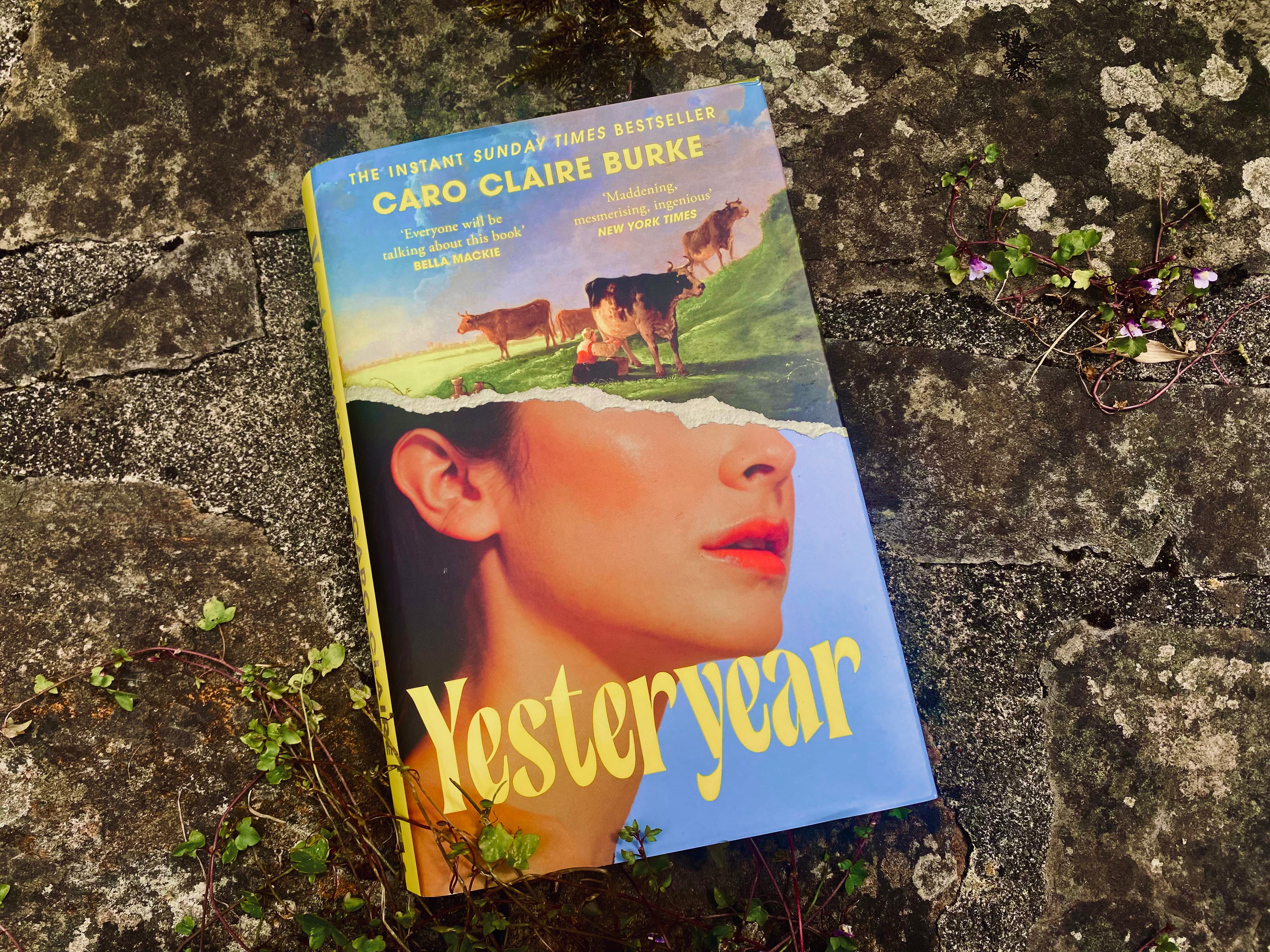
I am writing this in part to share my experience with other readers, but also to organise my own thoughts and feelings after having read something that left me wholly and utterly speechless and in knots. I’ve never in my life had an experience like this after finishing a book.
But let’s start at the beginning:
We all know by now that this book deals with the modern phenomenon of influencer culture.
By following Natalie – a so-called ‘tradwife’ influencer – around in her mind, we watch her build the illusion of a traditional farm life for her Instagram followers… only to wake up in the 1800s one day.
Everyone agrees that this is an interesting premise, because most of us are aware that influencer life is not exactly what it makes us believe it is.
So what would happen to someone who had to actually live the real version of that romanticised life, but with no opt-out button?
And we do see what happens to some degree, but it isn’t explored in great depth. This is why I think the book received some criticism. People expected a deep-dive into the What if scenario, but got a social commentary on today’s society instead.
Because it zooms in on all the controversial topics that drive people to hate each other these days, the sort of questions that cause deep divides and form a culture of extremes: You’re either with us or against us, no room to be a bit of this and, in other aspects, a bit of that, or neither. Impossible. Pick a side. You MUST pick a side! And be consistent - ALL. THE. TIME.
This intense pull between extremes, the expectation to be a an always coherent being and single minded in all aspects of life, is reflected in Natalie’s disintegrating mind.
It begins like this:
I woke up two minutes before my alarm went off, like usual. Five fifty-eight and bing: eyes wide open, ready to greet the day. I’ve never had a hard time waking up in the morning. Never used the snooze button, either, not once in my life. Sobriety helps. I don’t drink . Discipline helps, too. I was born with spades of discipline, I’m practically overflowing with it – which is why, I think, I’ve never had that much trouble with anything in my life. Not motherhood, nor marriage, nor building a business, nor serving Him. All of it appeared to me a series of tasks to be accomplished each day, at the right time, in the correct chronological order. I know it’s not that easy for other people, but it really is for me.
You can’t be serious, is what I was thinking reading this. NOBODY is perfect like that, or even seriously thinks they are. Does she really mean it?
So I read on.
The above passage makes it clear from the get-go that Natalie isn’t entirely serious, that this character can’t be taken for real. Because it is a satire. It’s meant to be exagerrated in order to spark reactions.
We very quickly learn that Natalie is a person of extremes: She values herself extremely highly and sees everyone else in an extremely negative light. She is aware that she needs to be kinder in order to be liked and make money from her followers, but she simply doesn’t feel it, or even cares, unless it serves her own needs and interests. In short: She is an unlikable, egotistical character.
I found her version of reality really interesting to follow. The extreme rage of it. Because I could understand - or somewhat relate to - some of her cold, analytical observations of today’s society.
For example that women have to work double as hard as men to get anywhere career-wise, and then lose out on life, because by the time they have reached financial security they are too old to have children - and their husband has run off with somebody younger.
Okay, maybe this is exaggerated and not true for everyone, but it isn’t uncommon either.
Also: Why do women have to want a career? What if one wants to have children instead and be a stay-at-home mum? The problem is, it’s often expected of women - by other women - to climb the career-ladder and if they choose to opt out, they’re frowned upon, judged, or even hated, like Natalie.
Hate seems to have become a pastime in this modern, social-media driven world, and is characterised by the Angry Women in this book - a faceless mass of women who spend their days watching and hating, because it is so easy to hate from a distance, hiding behind a screen.
And that is what this book, in my opinion, is all about: Holding up a mirror to you, the reader, because you – and I – are all part of the problem. We all watch and judge, sometimes hate, especially when reading this book, but it’s never our fault. It’s always them. It’s Natalie who hates everyone. Vile. A monster really. Because it’s definitely not me. Judging her, hating her, and doing so very publicly. All over the internet. No, not me.
Now how many posts have you seen about this book where someone says: I hate the main character. I hate Natalie. She’s a monster.
But what would happen if we admitted to ourselves, just for a moment, that part of Natalie lives inside of us too? What if we acknowledged that we are not perfect, have flaws and mean thoughts, sometimes even outright evil ones?
That, of course, would be ugly, unacceptable. So we pretend we don’t have them and instead hate even harder on those who embody what we try so hard to suppress in ourselves, what we feel ashamed of. Because it’s so much easier, a relief really, to point the finger at someone else, away from us. It makes us feel good about ourselves, lifts us above them. But it’s a lie.
Lying is a huge theme in this book. Lying and pretending that life is one way, when really it is often not as pleasant as it looks on the surface, especially in the influencer world.
Our daily little lies to ourselves and others run so deep that they infiltrate our consciousness to a degree we believe our own made-up fantasies.
Mothers telling their daughters It’ll all be fine once their daughter’s had a child and her entire life torn apart. But how can she know? Yes, many will be fine, but some might never recover, because they’re simply not wired that way.
Does that mean they deserve to be hated? Or does it give us, the onlooker, an excuse to hate someone for expressing something we hate about ourselves? Because we may have had a similar thought once and feel guilty about it?
I am not a mother, so I can’t draw from personal experience here, but – once upon a time – I used to have a positive outlook on life. I was a generally happy person. It didn’t touch me much what other people did, and it didn’t enrage me when someone had a different opinion from my own.
In fact, I had a diverse group of friends from all walks of life. There was a general acceptance that not everyone lives the same way. And that’s ok, in fact, it is enriching in the sense that you can adopt what works for you and leave what doesn’t.
I believe in humanity before political agenda or categorisation according to superficial markers. Humans are complex and unique in character, then shaped by the experiences life throws at them.
I had a few difficult years where nothing seemed to go right anymore. From dealing with severe illness in the family to having to sell a business and a disaster of a house project which caused me intense anxiety for the best part of a year and left me with a bit of trauma around being taken advantage of. There was a time I lost confidence in my own judgement and trust in others.
One day, I remember thinking to myself: When have I become so negative?
I realised that I had become that bitter, old woman - see, another judgement we all know and use without thinking.
I will admit that I had a lot of negative thoughts and feelings around other people. I felt like the world had it in for me. Relentlessly so. One punch after another, I barely had time to drag myself up before the next hit landed, in the gut. Always in the gut. It went on and on, and there were times I thought I was losing it a bit.
I became resentful and started judging everything and everyone around me. The neighbours playing music too loud. How inconsiderate. Can’t they, just for a minute, think about other people wanting a bit of peace and quiet? … that kind of thing, but in a tone and wording of inner rage… You get what I mean. A bit like Natalie, maybe with different wordings, but the same intensity.
Of course this particular sensitivity was just the response to a whole rat’s tail of triggers and conditioning: boarding school → bullying → nowhere to escape → existential angst. Triggers around personal space have always followed me around.
And it didn’t help that I had workers walk all over me and blast their bloody radio, if I liked it or not, throughout the house. A. WHOLE. YEAR. LONG!
But of course it is so much easier to externalise one’s own deep-rooted misery, fear and rage onto someone or something we can lash out at than pointing the finger back at that unshapely thing we can’t properly grasp - our own bruised souls.
I think this form of externalised aggression is a psychological mechanism to create a sense of relief when we feel out of control around something in our life and the extreme emotional pressure we experience as a result. Does that make us terrible people? I don’t think so.
I’ve thankfully recovered somewhat from what I’d describe as the three most aweful years of my life. I’ve found some sort of sanity, and yes, kindness, again. Both for myself and others. Because it’s important to remember to be kind to oneself too, you know, because the less you truly like yourself, the more poorly you may treat others.
Natalie clearly loathes herself, and compensates it by over-inflating her ego above everyone else that comes her way. It’s the only way she can survive, short of admitting to herself that her life is a car crash and she’s the driver. But that is a thought she simply can’t entertain. It would break her.
This is why I think it is important to ask WHY someone might be like they are, especially if they seem extreme. Even ask yourself when you notice yourself being off kilter what may be causing it.
Because we all have a story! Most people don’t get born angry, hateful or distrusting. It’s what happens to us and how we process it that makes us all those things.
And then there are some people who simply can’t help not feeling empathy, because they are born that way. What do you do about that? Is that a reason to hate them?
You see, this is only a snapshot of MY experience with this book. I come to it with my own story, experience of life and angle from which I view it.
Every person reading this book will have their own take on it based on their own world view and experience. But I think it is safe to say that it touches, or triggers, most people somewhere within themselves.
The ending of the book left me absolutely baffled. Not so much because of the twist, but because of the explosion of emotions the finale builds up to. There is sadness. There is love. There is anger. There is hope.
This book makes it possible to feel all of those seemingly incompatible emotions ALL AT ONCE. And that is what, in the end, made it so indescribably BEAUTIFUL to me. It’s an experience more than anything else, and invites you to reflect - on society, and yourself in it.
I would even go as far as say it teaches kindness in the most discombobulated way and, as such, effects the opposite of what it appears to be.
What do YOU think?
I am itching to hear your take on it, because there are soooo many ways to look at this and I could pick a multitude more topics, but this is the best I could do for a summary without breaking my brain all over again.
Did you love it? Or did you hate it?
Helene
I have to admit that I have not read this book yet because I'm so tired of influencer culture. However, I am interested in what it might say about society as a whole today. I really appreciate your take on this and the fact that you were so moved by it.
I love reading novels (especially thrillers) because they help me understand why people are the way they are. It's become so easy to judge others these days from the convenient distance of our phones. It's much harder to turn the mirror back onto ourselves and admit our own flaws.
In my opinion, the best books are the ones that stay with me for a while after I'm done reading them. If I can't stop thinking about them, I know the author has done their job well.
I might just add this one to my TBR list. :)